




 Pokemon Card Scanner
 Live Wallpapers Unlimited
Mastering Your Timepiece: A Complete Guide on How to Adjust Rolex Time in 2025
Owning a Rolex is a statement. It represents precision, craftsmanship, and timeless elegance. However, even the most exquisite mechanical marvels sometimes need a little human intervention. Whether you've just traveled across time zones, observed daylight saving changes, or simply want to ensure your watch is perfectly synchronized, knowing how to adjust Rolex time is an essential skill for any owner.
In this comprehensive guide for 2025, we'll walk you through every step. We will cover various models and functions, helping you confidently set your prized timepiece. You'll learn the proper techniques, understand the nuances of different models, and discover common pitfalls to avoid. Let's dive into mastering how to adjust Rolex time.
Why Your Rolex Needs Adjusting (Even in 2025)
Even though Rolex watches are renowned for their accuracy, several factors necessitate occasional adjustments. Travel is a common reason. When you cross multiple time zones, your watch needs to catch up or fall back. Daylight saving time changes also require you to adjust your watch twice a year.
Furthermore, while highly precise, mechanical watches can gain or lose a few seconds over time. This is completely normal. Regular adjustments ensure your Rolex remains perfectly aligned with official time. Knowing how to adjust Rolex time ensures your watch is always a reliable companion.
Understanding Your Rolex Crown: The Key to Adjustment
The crown, located at the 3 o'clock position on most Rolex models, is your primary interface for setting the watch. It's not just for winding; it's also how you adjust Rolex time and date functions. Rolex crowns are typically screw-down, a crucial feature for water resistance. You must unscrew it before you can pull it out to access different setting positions.
Each 'notch' or position the crown pulls out to serves a specific purpose. Understanding these positions is fundamental to correctly adjusting your watch without causing damage. Always handle the crown gently and deliberately.
- Position 0 (Screwed-down): This is the fully closed position, ensuring water resistance. The watch cannot be wound or set here.
- Position 1 (Unscrewed/Winding): After unscrewing, the crown is in this position. You can manually wind the watch here.
- Position 2 (First Notch): Pulling the crown out one click from Position 1 allows you to set the date (for models with a date function) or sometimes the GMT hand.
- Position 3 (Second Notch): Pulling the crown out two clicks from Position 1 (or one click from Position 2) allows you to set the time. This position typically 'hacks' the seconds hand, stopping it for precise synchronization.
Step-by-Step Guide: How to Adjust Rolex Time (Basic Models)
Let's begin with the most common scenario: adjusting the time on a standard Rolex model without a date or complex GMT function. This process is straightforward once you understand the crown's positions. Remember, patience and a gentle touch are key when you learn how to adjust Rolex time.
Step 1: Unscrew the Winding Crown
Before you can adjust anything, you must unscrew the crown. Turn the crown counter-clockwise until it releases from the case. You will feel it 'pop' out slightly. This action disengages the screw threads and allows the crown to move freely. Be gentle; never force it. For more detailed instructions on this initial step, you can review this helpful guide on how to set the time and date on a Rolex.
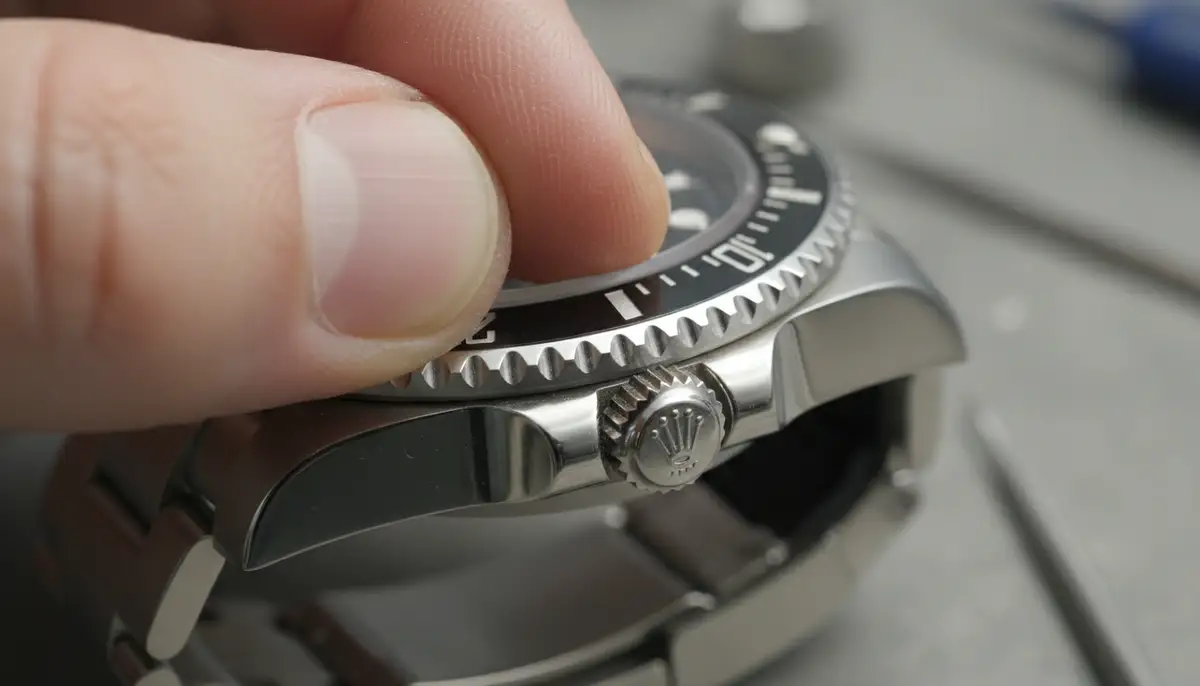
Once unscrewed, the crown is in the winding position (Position 1). If your watch has stopped, you might want to give it a few gentle clockwise turns to wind it slightly. This ensures it has enough power to run while you adjust the time.
Step 2: Pull the Crown to the Time-Setting Position
Carefully pull the crown outwards until you feel two distinct clicks. This is the second notch, or Position 3. In this position, the seconds hand will 'hack' or stop moving. This allows for extremely precise time setting. This precise mechanism is a hallmark of Rolex engineering. Further information on setting the time and date can be found on the official Rolex watch care and service page.
Step 3: Set the Time
Rotate the crown either clockwise or counter-clockwise to move the hour and minute hands. Move the hands forward past 12 o'clock to determine if you are setting AM or PM. The date will change if you pass midnight. This helps you avoid setting your watch 12 hours off. For a more comprehensive breakdown of the steps involved, check out this guide on how to set a Rolex watch.
Align the minute hand precisely with a reliable time source, such as an atomic clock or your smartphone. Once aligned, gently push the crown back into the winding position (Position 1). The seconds hand will start moving again. This completes the core process for how to adjust Rolex time.
Step 4: Screw the Crown Back In
This step is crucial for maintaining your Rolex's water resistance. Push the crown gently inwards while turning it clockwise. You should feel the threads engage. Continue turning until the crown is securely screwed down against the case. Do not overtighten, but ensure it is snug. A properly screwed-down crown protects your watch from dust and moisture. This is vital for its longevity.
How to Adjust Rolex Time with a Date Function (Datejust, Submariner Date)
Many popular Rolex models, like the Datejust and Submariner Date, include a date complication. Adjusting these requires an extra step, utilizing the first notch of the crown. The process for how to adjust Rolex time with a date is slightly more involved but still straightforward.
Setting the Date
First, unscrew the crown as described in Step 1. Then, pull it out to the first notch (Position 2). This is the quickset date position. Turn the crown clockwise (for most models) to advance the date window. Continue turning until the correct date appears. Avoid setting the date when the time is between 9 PM and 3 AM, as this can damage the date mechanism. This period is often called the 'danger zone'.
Setting the Time (After Date)

Once the date is set, pull the crown out one more click to the second notch (Position 3). The seconds hand will stop. Now, rotate the crown to set the correct time, ensuring you pass 12 o'clock if you need to advance into the next day. Synchronize the minute hand with your reference time, then push the crown back in. Finally, screw it down tightly. This ensures you correctly adjust Rolex time and date.
For a visual guide on this process, especially for models like the Datejust, you might find this video helpful:
. It provides clear demonstrations of each step.Adjusting Rolex Time on GMT Master II (Dual Time Zones)
The GMT-Master II is a traveler's watch, designed to display two or even three time zones simultaneously. This makes knowing how to adjust Rolex time on this specific model crucial for global adventurers. Its independent hour hand and 24-hour GMT hand require a slightly different approach.
Setting the Local Time (Independent Hour Hand)
Unscrew the crown. Pull it out to the first notch (Position 2). Unlike other models, in this position, you can rotate the crown clockwise or counter-clockwise to move the main hour hand independently, without affecting the minute or GMT hands. This is perfect for quickly changing your local time when you land in a new time zone. Advance or reverse the hour hand to the correct local time, ensuring the date changes if you cross midnight.
Setting the GMT Hand (Home Time) and Minute Hand
After setting the local hour, pull the crown out to the second notch (Position 3). Now, the minute hand and the 24-hour GMT hand will move together. Rotate the crown to set the minute hand to the precise minute. At the same time, set the GMT hand to your home time or a reference time zone, reading it against the 24-hour bezel. Once set, push the crown back in and screw it down. This intricate process allows you to precisely adjust Rolex time for multiple zones.
Specific Rolex Models and Their Time Adjustment Nuances
While the principles of how to adjust Rolex time remain consistent, some models have unique features. The Rolex Sky-Dweller, for example, uses a 'Ring Command' bezel to select which function the crown will adjust (time, date, or annual calendar). The Daytona, being a chronograph, has pushers in addition to the crown for its stopwatch functions.
Always consult your specific model's user manual for the most accurate and detailed instructions. Rolex provides excellent guides for each of its watches. However, the general steps for how to adjust Rolex time will apply to most models.
| Rolex Model | Crown Position 1 (Unscrewed) | Crown Position 2 (First Notch) | Crown Position 3 (Second Notch) |
|---|---|---|---|
| Submariner (No Date) | Winding | N/A | Time Setting (Hacking) |
| Submariner Date, Datejust | Winding | Date Quickset | Time Setting (Hacking) |
| GMT-Master II | Winding | Independent Hour Hand (Local Time) | GMT Hand & Minute Hand (Hacking) |
| Daytona | Winding | N/A | Time Setting (Hacking) |
| Explorer I | Winding | N/A | Time Setting (Hacking) |
Beyond Basic Adjustment: Maintaining Your Rolex
Knowing how to adjust Rolex time is just one part of being a responsible owner. Proper care extends the life and maintains the value of your watch. Regular winding, especially if you don't wear it daily, keeps the movement lubricated. Consider a watch winder for automatics if you have multiple watches.
Regular servicing by an authorized Rolex service center is also vital. They perform essential maintenance, clean the movement, and replace worn parts. This ensures your watch continues to perform flawlessly for decades. While traditional watches like Rolex demand this care, the world of timekeeping is evolving. For those interested in a detailed comparison of traditional luxury watches vs smartwatches, there's a fascinating discussion to explore.
Speaking of smartwatches, if you enjoy customizing your digital timepieces, platforms like WatchMaker offer thousands of watch faces for Apple Watch and Wear OS devices. While a Rolex is a physical masterpiece, digital watch faces allow for endless personalization. Companies like Pujie Black also offer robust customization options for smartwatch enthusiasts, showcasing the diverse landscape of horology today.
Common Mistakes to Avoid When You Adjust Rolex Time
Even experienced owners can make errors. Being aware of these common mistakes will help you protect your investment when you adjust Rolex time.
- Forcing the Crown: Never apply excessive force when unscrewing, pulling out, or pushing in the crown. Rolex movements are precise, and forcing components can cause significant damage.
- Setting the Date During the 'Danger Zone': As mentioned, avoid adjusting the date between 9 PM and 3 AM. This is when the date change mechanism is engaged, and manual adjustment can strip gears.
- Not Screwing Down the Crown Properly: Failing to fully screw down the crown compromises the watch's water resistance. This makes it vulnerable to moisture and dust, which can lead to costly repairs.
- Ignoring the User Manual: While this guide provides general instructions, your specific Rolex model may have unique features or a slightly different adjustment procedure. Always refer to your watch's official manual.
- Overwinding: For manual wind models, stop winding once you feel firm resistance. Forcing it further can damage the mainspring.
When to Seek Professional Help
Most of the time, you can confidently adjust Rolex time yourself. However, there are instances when professional intervention is necessary. If the crown feels stuck, won't unscrew, or doesn't pull out to the correct positions, do not force it. Take your watch to an authorized Rolex service center or a reputable watchmaker.
Additionally, if your watch is consistently running significantly fast or slow, it may indicate a need for servicing. A watchmaker can diagnose and resolve internal movement issues. They ensure your Rolex maintains its legendary accuracy. For those balancing the precision of a Rolex with the functionality of modern wearables, exploring expert insights into choosing your ideal fitness companion can offer a broader perspective on watch technology.
In the digital watch face market, companies like watchfacely.com and amoledwatchfaces.com also provide extensive customization options. These platforms allow users to personalize their smartwatches, much like a Rolex owner appreciates the unique design of their mechanical timepiece. However, when it comes to mechanical watches, professional care is paramount.
Maximizing Your Rolex Experience in 2025
Your Rolex is more than just a time-telling device; it's a piece of art and engineering. By understanding how to adjust Rolex time correctly and maintaining it with care, you ensure its legacy continues. In 2025, amidst a world of smart devices and instant information, the ritual of setting a mechanical watch remains a unique pleasure. It connects you to a tradition of precision and craftsmanship.
Embrace the knowledge you've gained today. Use it to confidently manage your Rolex's timekeeping. This ensures it always reflects the correct time, wherever your journey takes you. For those who appreciate detailed time displays, whether on a traditional watch or a modern smartwatch, exploring various health watch faces can enhance your daily routine.

Conclusion
Mastering how to adjust Rolex time is a valuable skill for any owner. It ensures your timepiece remains accurate and functional, reflecting the precision it was designed for. From unscrewing the crown to setting the minute hand, each step is part of a ritual that connects you to your watch. Remember to be gentle, follow the specific instructions for your model, and always screw the crown down securely.
With this guide, you are now equipped to confidently adjust Rolex time for any occasion or time zone change. Enjoy the timeless elegance and unwavering reliability of your Rolex, knowing you have the expertise to keep it running perfectly. Your Rolex is built to last, and with proper care, it will continue to mark your moments for generations to come.
Related Posts

The Watch Face Mistake Almost Every New Garmin Owner Makes
There's a predictable arc to owning a new Garmin. Day one, you install a watch face that shows everything: heart rate, steps, battery, weather, two time zones,...

The Ultimate Apple Watch Strap Guide: Find Your Perfect Fit & Style in 2025
Introduction: Your Essential Apple Watch Strap Guide for 2025 Your Apple Watch is more than just a gadget. It's a personal statement, a fitness tracker, and a...